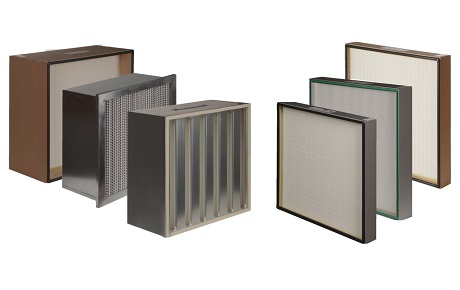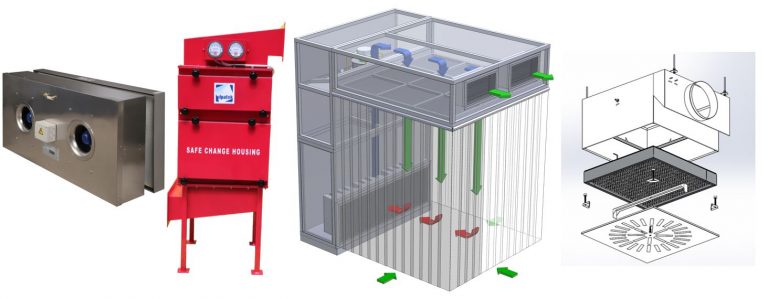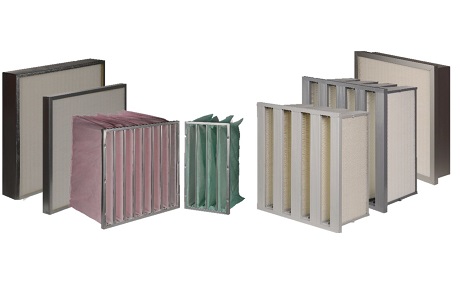
An H13 filter must achieve at least 99.95% overall efficiency at MPPS; H14 raises that minimum to 99.995%. H14 allows one-tenth of H13’s maximum overall penetration. To choose between them, you still need to check the application, airflow, installation and acceptance requirements. EN 1822-1:2019, classification table
An existing specification requiring H14 is straightforward: supply H14. A new design is where the useful questions begin. What contamination reaches the filter? What is generated inside the space? Which particles matter to the process? Can the system maintain its required airflow as the filters load?
The difference is in penetration
When efficiencies have several nines, penetration is easier to compare.
| EN 1822 class | Minimum overall efficiency at MPPS | Maximum overall penetration | Maximum local penetration, reference MPPS scan |
|---|---|---|---|
| H13 | 99.95% | 0.05% | 0.25% |
| H14 | 99.995% | 0.005% | 0.025% |
Scroll the table sideways to see all columns →
The local limits concern the defined filter-element test. They are not universal acceptance limits for installed photometer testing. The class values are also shown in the VDMA overview of filter classes.
For an illustrative challenge containing 100,000 particles at the tested size, class-limit overall penetration corresponds to 50 passing particles for H13 and five for H14. Actual compliant filters can perform better than their class minimum. These are arithmetic equivalents of the limits, not expected particle counts in a cleanroom.
The difference is easier to see in penetration.
For the same illustrative challenge of 100,000 particles at MPPS:
MPPS means most penetrating particle size: the size at which the filter has its lowest efficiency under the test conditions. It is not automatically 0.3 µm. ISO 29463-5:2022 addresses efficiency at MPPS and includes provisions for filters whose MPPS falls below 0.1 µm. ISO 29463-5:2022
This is why “99.97% at 0.3 µm” should not be silently rewritten as “H13” or “H14.” A specification tied to a different particle size or test method needs evidence against that requirement.
An ISO cleanroom class is not a filter class
ISO 14644-1:2015 classifies air cleanliness by measured airborne particle concentration. H13 and H14 classify filter performance. There is no direct conversion table between them in ISO 14644-1. ISO 14644-1:2015
For example, a room can receive very clean supply air and still have excessive particles from its process, occupants, equipment or material transfers. Changing H13 to H14 reduces penetration through the filter under comparable conditions. It does not remove an uncontrolled source beside the product.
That also explains why H14 does not automatically produce faster cleanroom recovery. Recovery depends on the airflow and how effectively it removes or dilutes contamination, as well as the supply-air cleanliness and continuing sources. If the replacement reduces delivered airflow, the higher filter class alone does not tell you the net result.
Check both filter performance and room performance during design and qualification.
What EU GMP Annex 1 actually asks for
The 2022 Annex 1 requires suitable filtration efficiency for the premises and includes installed filter leakage/integrity testing among relevant qualification checks. It defines the contamination control strategy and the conditions required for the different grades. It does not contain an H13-to-H14 selection table. European Commission, EU GMP Annex 1, sections 2.3, 4.1 and 4.25
For a new critical aseptic supply specification, H14 is a sensible candidate to assess first, alongside the airflow, equipment configuration and qualification requirements of the process. This is an engineering starting point, not a claim that Annex 1 explicitly mandates H14.
If someone proposes H13 for a design already based on H14, the answer is not “both are HEPA.” They need to show why the changed specification remains suitable and follow the project’s change-control requirements. The filter class is part of the agreed design.
A decision table you can actually use
Use the table to start a design review. It does not replace the project specification or national requirements, and it is not a direct conversion from room class to filter class.
| Application | Where to start | What decides the final selection |
|---|---|---|
| Existing qualified installation | Retain the approved class | A change in class, pressure drop or seal must be assessed against the existing design and acceptance requirements |
| New critical aseptic zone, including a Grade A work zone | Evaluate H14 terminal filtration first | Process protection, barrier design, first-air coverage, installed integrity and qualification results |
| Grade B background to an aseptic process | Evaluate H14; check the complete room design | Operational contamination sources, airflow and the specified conditions for the background area |
| Grade C/D or ISO 7/8 production room | Evaluate the actual need for HEPA; H13 can be a candidate where terminal HEPA is specified | Particle and microbial risks, upstream filtration, process emissions and the approved design basis |
| Non-pharmaceutical clean manufacturing, including optics and electronics | Compare H13, H14 or ULPA against the critical particle sizes | Process-specific cleanliness at the product, not the room’s ISO number alone |
| Hospital operating theatre | Use the applicable healthcare ventilation specification and room type | The local standard, surgical environment and complete ventilation system; “hospital = H14” is not a specification |
| Protective environment or airborne infection isolation room | Identify whether the requirement concerns supply, recirculation or exhaust | Patient protection versus containment, pressure direction, discharge arrangement and the applicable healthcare requirements |
| General commercial HVAC | Check whether HEPA is required at all | A suitable ISO 16890 filter train may be the appropriate design; confirm airflow and the particulate-removal objective |
Scroll the table sideways to see all columns →
The hospital row deserves more than a class label. CDC guidance distinguishes protective environments, which protect susceptible patients, from airborne infection isolation rooms, which contain infectious air. Its requirements also distinguish direct exhaust from recirculation. First check whether the room protects the patient or contains contaminated air, and where the exhaust goes. A higher filter class alone does not make an unsuitable exhaust location acceptable. CDC environmental infection-control guidance: air
For a room air cleaner, assess the complete device as well. NHS England’s HEPA-device guidance discusses in-situ performance, airflow and deployment alongside filter classification. A high-class filter operated at too little airflow is not a complete air-cleaning solution. NHS England NETB 2023/01A
Does H14 always have a higher pressure drop?
The class does not prescribe a pressure drop. Media properties, media area, pleat geometry, frame depth and airflow determine the actual figure.
Within a comparable product family, H14 can have a higher initial resistance. Here is a specific Ulpatek example rather than an industry-wide percentage:
| Catalogue model | Dimensions | Nominal airflow | Published initial pressure drop |
|---|---|---|---|
| HC-H13-A-3-610-610-100-FB-P | 610 × 610 × 100 mm | 600 m³/h | 75 Pa |
| HC-H14-A-3-610-610-100-FB-P | 610 × 610 × 100 mm | 600 m³/h | 90 Pa |
Scroll the table sideways to see all columns →
The 2024 catalogue lists 75 mm pleats for both and a differential-pressure tolerance of ±10%. The listed difference is 15 Pa, or 20%, for these models at this airflow. It is not a guarantee that all H14 filters impose a 20% penalty. Ulpatek Product Technical Catalogue, p. 145
Ask for the pressure-drop curve at your actual design airflow. Comparing two catalogue values at different nominal flows is not a fair comparison. Also check the fan’s available pressure as the filter loads; initial resistance is only the starting condition.
Factory test evidence and site acceptance are separate decisions
Do not write only “HEPA, individually tested” and assume every supplier understands the same method.
Specify the classification standard and the required leak-test method. The reference method scans with particle counting; permitted alternatives depend on the class and the applicable standard. EN 1822 and ISO 29463 are related, but their permitted test routes are not identical. If your project requires an individual MPPS scan report, say so. EN 1822-1:2019, section 7.4, ISO 29463-4 test-method scope
Then define the installed test separately. Changing from H13 to H14 does not, by itself, specify a new photometer, a scan speed or a universal site leak limit. Those belong to the agreed test procedure.
Put the missing information into the enquiry
For a usable quotation, send:
- The required class and standard, with any project-specific test requirement.
- Airflow per filter and the maximum acceptable initial pressure drop at that airflow.
- Actual frame dimensions and the available depth.
- Gasket or gel arrangement, sealing side and housing drawing.
- Operating temperature and any cleaning or decontamination exposure.
- The required individual documentation and installed acceptance procedure.
Related product information: HEPA ceiling filters.
Frequently asked questions
Does ISO Class 5 require an H14 filter?
ISO 14644-1 defines particle-concentration classes, not mandatory H13 or H14 filters. The design must achieve the required cleanliness for its intended use. H14 may be an appropriate choice, but its label does not establish ISO Class 5 compliance for the room.
Is an H14 filter ten times better than H13?
Its maximum permitted overall penetration at MPPS is ten times lower: 0.005% instead of 0.05%. That comparison applies to the class limits. It does not mean ten times cleaner room air, ten times longer life or ten times lower infection risk.
Can I replace H14 with H13 to reduce energy use?
Only after the change is assessed against the approved design. Check contamination-control requirements and compare measured resistance at the same airflow. Also consider an H14 construction with more media area or greater depth where the housing allows it.
Does an H14 label guarantee a successful site integrity test?
No. The installed result also depends on handling, the filter-to-housing seal, the housing and the test method. Request the factory evidence and specify the installed acceptance requirements before ordering.
Sources
- EN 1822-1:2019, classification table
- VDMA overview of filter classes
- ISO 29463-5:2022
- ISO 14644-1:2015
- European Commission, EU GMP Annex 1, sections 2.3, 4.1 and 4.25
- CDC environmental infection-control guidance: air
- NHS England NETB 2023/01A
- Ulpatek Product Technical Catalogue, p. 145
- ISO 29463-4 test-method scope
- HEPA ceiling filters