610 × 610 mm and 592 × 592 mm can describe two different filters. Do not convert one to the other because both appear in systems described as “600 mm” or “24 inch.” The replacement must match the actual filter and its housing interface.
This is where an apparently simple quotation goes wrong. One person sends the ceiling module size, another measures the filter frame, and a third copies an inch label from an old schedule. All three believe they have supplied the dimensions.
Before asking for a price, identify what each number measures.
Nominal size is a label; actual size is a dimension
A nominal size is a convenient product or module designation. Its relationship to actual dimensions depends on the manufacturer's system. There is no universal deduction that turns every nominal air-filter size into the correct outside frame size.
An actual dimension refers to a defined physical feature, with a tolerance. That feature might be the filter frame, flange, housing body, clear opening or diffuser. The word actual is useful only when the feature is named.
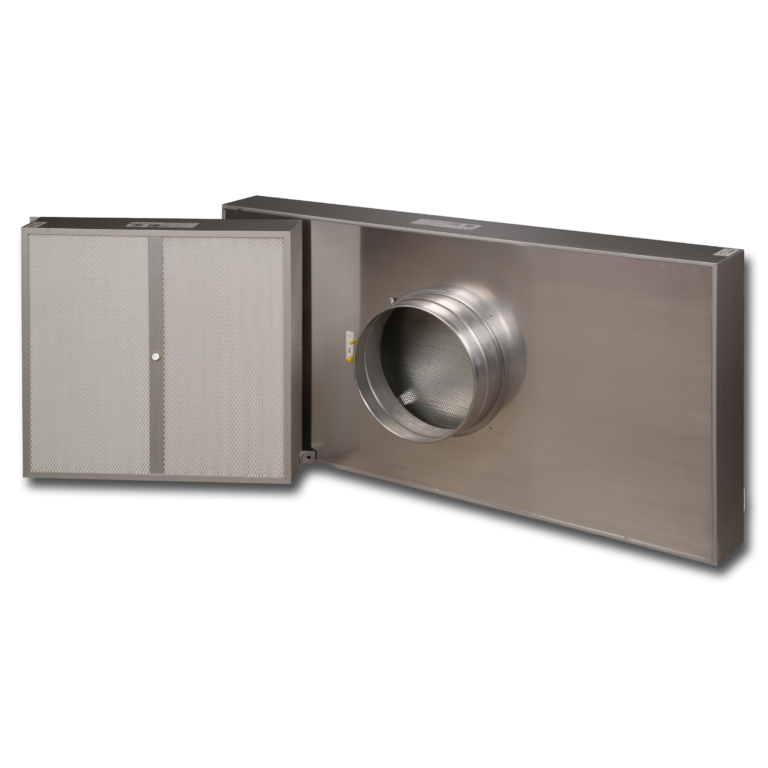
Ulpatek's tool-free HEPA box manual lists 592 × 592 and 610 × 610 mm filters separately. That is direct evidence that they should not be treated as interchangeable versions of one measurement. Ulpatek tool-free HEPA box manual, section 3.1.
Where the inch numbers help—and where they do not
The exact conversion of 24 inches is 609.6 mm. Twelve inches is 304.8 mm, and 11.5 inches is 292.1 mm. These conversions explain why 610, 305 and 292 mm are familiar dimensions in filter catalogues.
They do not explain every 592 mm frame or prove that a product sold with a 24-inch nominal label has a 609.6 mm actual frame. Nominal clearance conventions can be different.
Keep the original units when asking about an existing product. If a drawing states an inch dimension and tolerance, send both. Do not round it to a convenient metric number, then add a second unapproved clearance because “filters are usually smaller.”
For illustration, the difference between 610 and 592 mm is 18 mm. If a smaller square were centred in a larger square opening, that would be 9 mm on each side. That arithmetic says nothing about seal contact, because the real housing may have rails, a flange or a sealing land occupying part of the opening.
The 292 mm dimension is usually depth—but say so
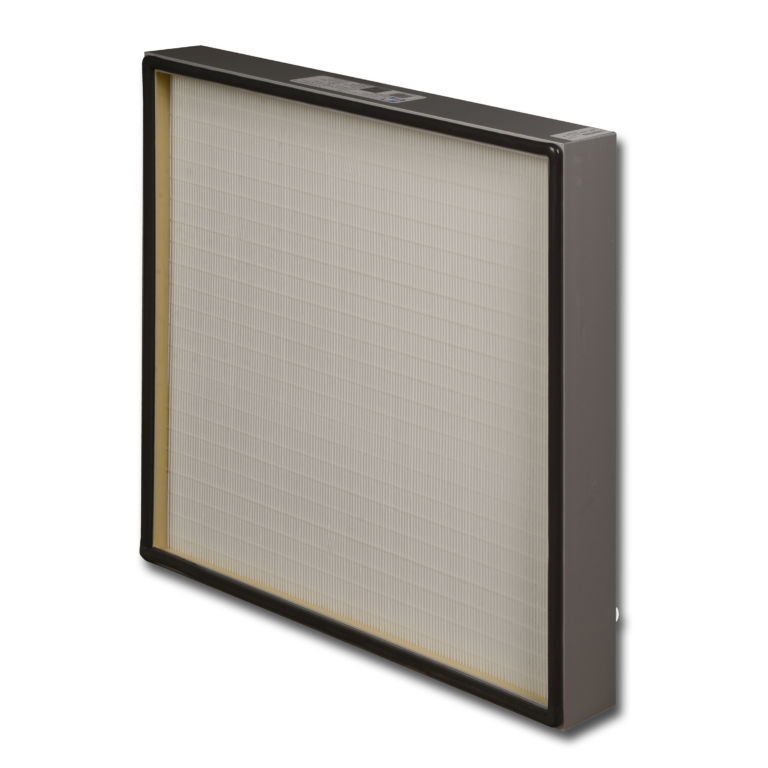
For the common rectangular format W × H × D, width and height describe the filter face; depth runs along the intended airflow direction. A 592 × 592 × 292 mm entry therefore usually describes a roughly square face and a deep element.
However, W × L × H and other notation also appear in drawings. Do not let a letter convention decide the orientation by itself. Label the face axes and show an airflow arrow on a section drawing.
A 292 mm frame depth does not identify the internal pack design. Single-pleat and V-module products can use the available volume differently. Ulpatek lists both constructions in its high-efficiency range. Ulpatek absolute-filtration products.
It also does not tell you whether a gasket projects beyond the quoted depth or whether a flange is included. State those measurement boundaries explicitly.
Filter, box and diffuser dimensions must stay separate
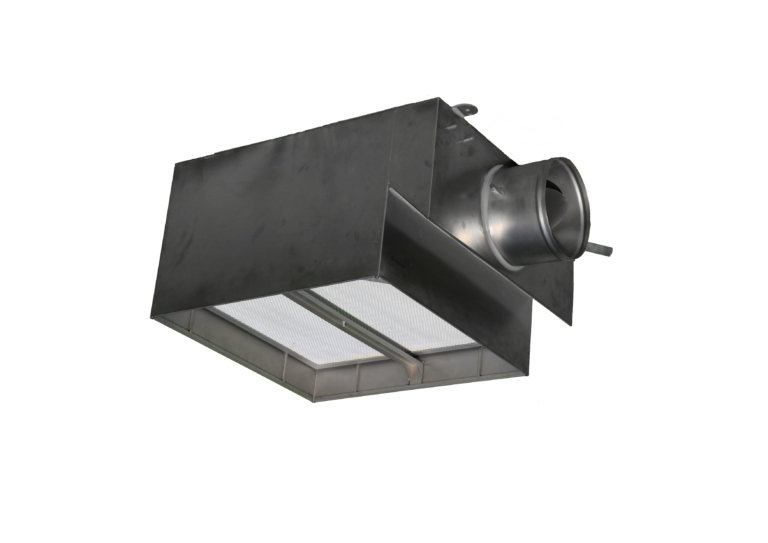
Ulpatek's HEPA box product table gives a useful example: a 610 × 610 × 78 mm filter is associated with a 627 × 627 mm box and a 650 × 650 mm diffuser. Each number describes a different component. These are model-specific values, not a general formula. Ulpatek HEPA filter box.
Sending “650 square” to a filter supplier could therefore order the size of the visible diffuser instead of the hidden filter. Measuring a ceiling opening can create a similar error.
For a room-side replacement, access the existing element through the approved maintenance process and record its identification and dimensions. If that cannot be done before quotation, label the available dimension honestly: “diffuser outside size,” “housing label,” or “drawing dimension.” Do not silently promote it to an actual filter size.
Measure a useful reference, not an old deformation
An old filter may be bowed, damaged or compressed at its seal. Take measurements at more than one location where practical and record the condition. Do not copy a distorted corner as the required manufacturing size.
For a rectangular element, record the outside frame width, height and depth, then the flange and gasket details separately. Check the drawing tolerance against the housing clearance. A filter that enters the opening can still miss the sealing surface or leave the retaining mechanism with insufficient travel.
A nominal fit should also allow removal. A replacement that can be forced into position but cannot be withdrawn safely has not solved the maintenance requirement.
Do not remove or alter the gasket just to make the frame fit. That changes the interface the replacement is supposed to reproduce.
A quotation request that avoids three rounds of email
Send the following information in one package:
| Item | A clear description |
|---|---|
| Identification | Existing manufacturer, model and readable label photograph |
| Outside dimensions | Actual frame W × H × D in mm, with axes labelled |
| Measurement boundary | Whether flange, gasket or other projection is included |
| Seal | Type, side, dimensions and position on the frame |
| Housing | Model or section drawing showing the mating surface |
| Duty | Required airflow, filter class and allowed pressure drop |
| Access | Installation and withdrawal direction |
Scroll the table sideways to see all columns →
If you have an approved drawing, give its revision. A correct drawing from an obsolete housing version can be as misleading as no drawing.
Keep the dimensions in the purchase order aligned with the approved quotation. Do not shorten a confirmed 592 × 592 × 292 mm element to “600 × 600 HEPA” when entering the order into a purchasing system.
Confirm fit and performance separately
After the dimensions are correct, check class, airflow and resistance. Equal outside dimensions do not establish equal filtration performance; equal H14 classes do not establish mechanical interchangeability. The filter-element standards address performance under defined test conditions, while the installation still needs a suitable interface. ISO 29463-1:2024.
610 and 592 are not competing ways to round the same number. Order the dimension the installation actually requires.