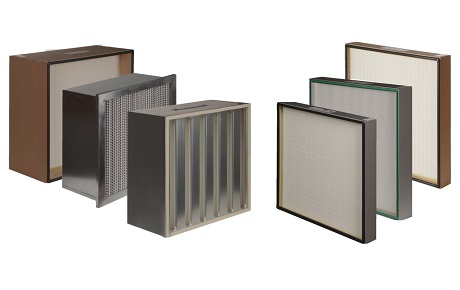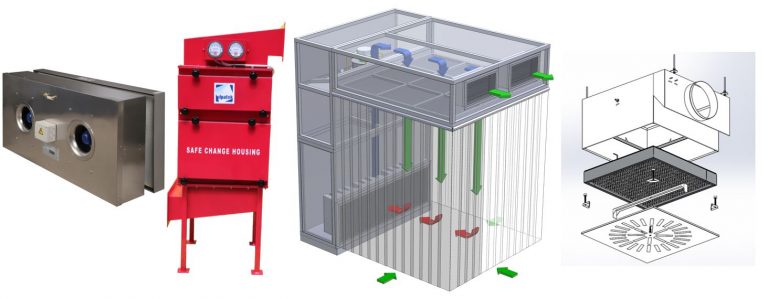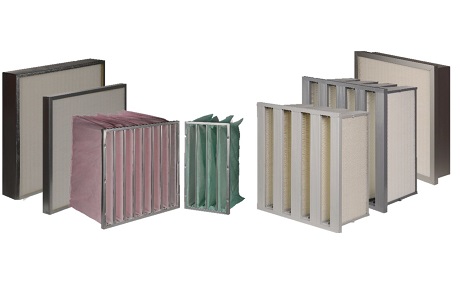
A replacement HEPA filter must match the housing's seal, mounting arrangement and operating duty. Width and length alone are not enough. For a rectangular filter with a compression gasket, confirm six dimensions on an approved drawing: frame width, frame length, frame depth, gasket width, uncompressed gasket height and gasket setback.
That is a purchasing checklist, not an EN 1822 dimensional standard. Gel seals, knife-edge frames, flanged filters and other arrangements require their own interface details. A filter can fit through the opening and still fail to seal.
First, identify which part you are measuring
The ceiling opening, diffuser, housing and replaceable filter are different components. Their dimensions are not interchangeable.
One Ulpatek HEPA Filter Box configuration illustrates the point: the published table gives a 610 × 610 × 78 mm filter, a 627 × 627 mm box and a 650 × 650 mm diffuser. Ordering a filter from the diffuser measurement would produce the wrong part. Other configurations have other dimensions; this is an example, not a conversion rule. Ulpatek HEPA Filter Box
Start with the housing identification, the installed filter's complete model code and the latest approved assembly drawing. Check that the drawing matches the installed equipment. Earlier changes or replacements may make an old purchasing record misleading.
Do not remove an operating filter simply to measure it. Use drawings, labels and maintenance records first. If inspection is needed, follow the facility's approved maintenance procedure and the access and contamination controls for that area.
The six dimensions: put them on the same drawing
For an ordinary rectangular compression-gasket filter, the following six dimensions give the manufacturer a useful starting point. Specify millimetres, identify the viewing direction and distinguish bare-frame dimensions from dimensions including the gasket.
In this checklist, W and L are the two outside dimensions in the filter face; D is the frame depth along the intended airflow direction. Mark that direction on the section drawing.
| Dimension | What to specify | What it decides |
|---|---|---|
| 1. Frame width, W | Actual outside width of the frame | Whether the filter enters and locates correctly |
| 2. Frame length, L | Actual outside dimension along the other face axis | Whether the frame matches the housing along its other axis |
| 3. Frame depth, D | Bare-frame depth; identify any projecting flange separately | Whether the clamps, supports and diffuser have clearance |
| 4. Gasket width, b | Width of the gasket contact strip on the filter face | Whether the seal lies fully on the housing's seating surface |
| 5. Gasket height, h | Uncompressed projection above the frame face | Whether the clamping arrangement can achieve the specified compression |
| 6. Gasket setback, s | Distance from the frame's outside edge to the gasket's outside edge | Whether the gasket aligns with the seat around the complete perimeter |
Scroll the table sideways to see all columns →
These letters explain this checklist. Match them to the labels on the manufacturer's drawing. If the setback or strip width differs by side, give the dimension for each side.
Why include setback? Because two filters can have identical outside dimensions and the same gasket material while placing the seal on different lines. A wider gasket is not automatically a solution. Part of it may overhang the seat or interfere with a test groove.
For a flanged frame, include flange width, thickness and position in the section drawing. For a gel seal, replace the compression-gasket detail with the complete gel-channel and mating knife-edge geometry. The six-number checklist cannot approve those interfaces by itself.
Nominal size is not a manufacturing dimension
“600 square” or “24-inch filter” is not enough for an order. Nor should 592 mm and 610 mm be treated as two names for a universally interchangeable size. Ulpatek's Tool Free documentation lists 592 × 592 and 610 × 610 mm filter options separately. Use the specified actual dimensions and tolerances for the particular housing. Ulpatek HEPA Filter Box Tool Free manual, section 3.1
The worn gasket on a removed filter is also a poor guide to its original thickness. Its compressed shape does not tell you the design height or intended clamp travel. Ask for the original gasket specification, or have the supplier check the seal arrangement against the housing and filter drawings.
Gasket check 1: is it the right sealing arrangement?
Identify both mating parts. “Gel seal” is incomplete if nobody has said which part carries the gel and which carries the knife edge.
| Arrangement | Required match |
|---|---|
| Compression gasket on the filter | Compatible housing seat and a clamping system designed to compress that gasket |
| Gel channel on the filter | Matching knife edge on the housing or equipment |
| Knife edge on the filter | Matching gel channel in the housing or ceiling system |
| Testable gasket-seat arrangement | The specified gasket profile, seat geometry and usable test connection |
Scroll the table sideways to see all columns →
Ulpatek's tool-free box manual shows a filter gel channel engaging with a knife edge on the housing. It also distinguishes that interface from a flat seat for a compression gasket. Match the complete pair, not only the outside dimensions. Ulpatek tool-free HEPA box manual, section 3.3
Gasket check 2: is the material suitable for the duty?
Specify the gasket material and construction, its location relative to airflow, and the actual operating conditions. Include temperature, humidity or condensation exposure and any cleaning or decontamination agents that can reach it.
Do not replace a gasket based on its material name alone. “Silicone,” “EPDM” and “PU foam” cover different grades with different compression and chemical-resistance limits. The supplier needs the exact grade or an agreed replacement specification.
The gasket also does not set the temperature rating of the entire filter. Media, separators, frame and pack-to-frame sealant remain part of the assembly. Ulpatek's gel ceiling filter, for example, has a published maximum operating temperature of 80°C for that product construction. Changing the outer seal does not give the complete filter a higher rating. Ulpatek Gel Type HEPA Ceiling Filter
Gasket check 3: can the housing apply the right compression?
Ask for the specified compression or installation setting for the actual gasket and clamp design. The same number of turns or torque setting cannot be used for every HEPA filter.
Check the seat condition, clamp positions and available travel. A bent seat, damaged support or clamp with no adjustment left is a housing problem. Ordering a thicker gasket without checking the assembly may simply create a different problem.
Ulpatek's Tool Free manual explicitly warns that excessive tightening can damage the filter. The same document directs installers to the product drawing for additional assembly information. Ulpatek Tool Free manual, sections 5 and 8
Handling matters too. Keep contact on the outer frame and protect the filter pack during unpacking and installation. The US Department of Energy's handling guidance makes that distinction explicitly. Follow the instructions for the actual filter and its packaging. DOE air-cleaning handbook, section 4.1.5.4
A mechanically correct replacement can still be the wrong filter
Once fit and sealing are confirmed, check the required filter class, airflow, initial pressure drop at that airflow and allowable operating conditions. “Same H14, same size” does not specify the complete duty.
Ask for the replacement's pressure drop at the installation's required airflow, rather than comparing unrelated catalogue points. Ulpatek's tool-free box manual lists frame depth, airflow and initial resistance for the selected complete filter. Use equivalent duty points when checking a replacement. Ulpatek tool-free HEPA box manual, section 4.2
The approval package should therefore contain:
- Housing identification and the approved filter/interface drawing, including tolerances.
- Complete replacement model, filter class and required test documentation.
- Required airflow and corresponding initial pressure drop.
- Gasket or gel specification, sealing side and mounting requirements.
- Operating conditions and the facility's installation and verification requirements.
Keep the individual filter identification linked to its factory documentation. Then verify the installed system under the applicable site procedure. ISO 14644-3:2019 addresses cleanroom test methods; a factory report does not, by itself, establish that the replacement is correctly installed in your particular housing. ISO 14644-3:2019
Questions that stop a bad order
Can I replace another manufacturer's HEPA filter with an Ulpatek filter?
Yes, when the mechanical interface, sealing arrangement and required performance match. Send the complete model information and drawings. Brand equivalence cannot be established from a photograph and three outside dimensions.
Can a deeper filter be installed to reduce pressure drop?
Only after checking available depth, clamp engagement, seal position, diffuser clearance and performance at the required airflow. A possible pressure-drop benefit does not establish mechanical compatibility.
Is the gasket supplied on the upstream or downstream face?
Specify it on the drawing with an airflow arrow. Either arrangement exists in filter products; the correct one is the arrangement designed for the housing. “Gasket on one side” leaves the purchasing specification unfinished.