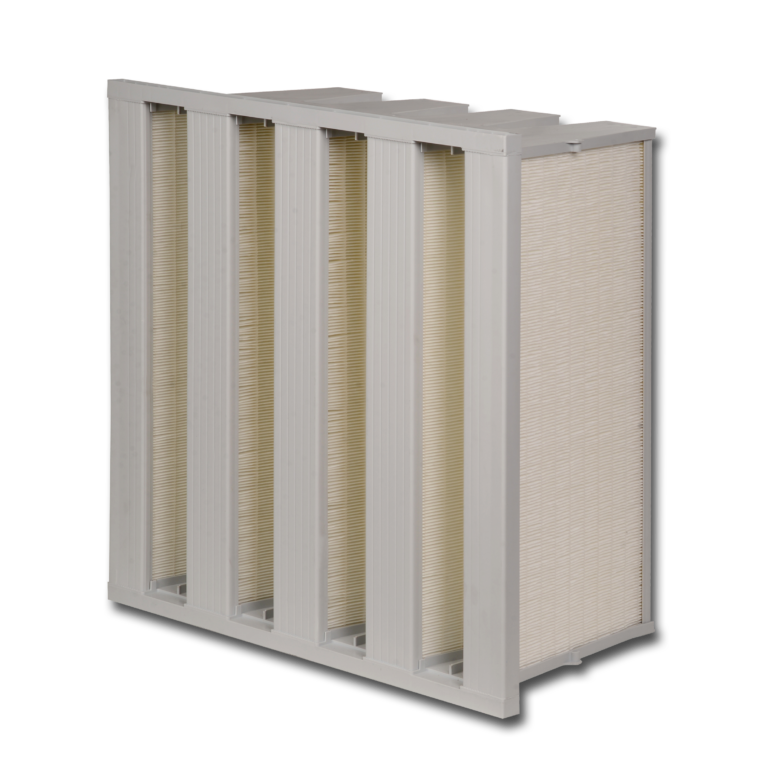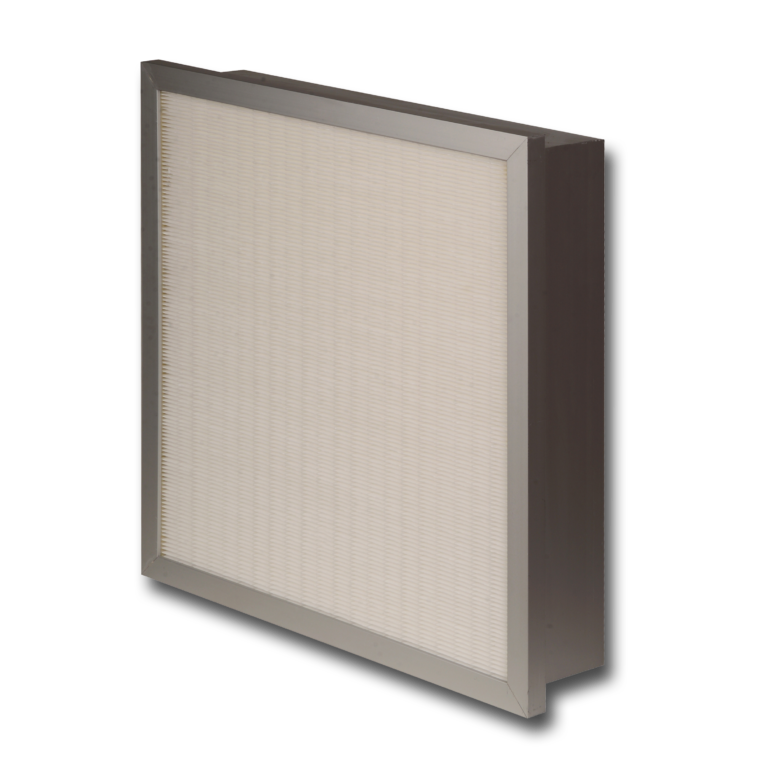
An A+ filter does not have one universal annual energy limit. Eurovent's limit depends on the particulate-efficiency group and the declared efficiency band. An ePM1 50% filter and an ePM1 80% filter can both be A+ while having different rated energy values.
The energy class is useful because it adds a comparable resistance-related measure to the filtration result. It becomes misleading when buyers compare the letter alone, ignore the filtration duty or treat the rating as an electricity-meter forecast for their own building.
The current Air Filters Technical Certification Rules, ECP 11 FIL 2026, contain the class tables used here. The energy calculation reference remains Eurovent 4/21-2019. Eurovent 2026 certification rules, Eurovent 4/21-2019
What the energy value represents
A filter creates resistance to airflow. Moving the required air through that resistance requires fan power. For a useful energy comparison, the resistance needs to be assessed over loading, rather than only when the filter is new.
Eurovent 4/21 uses a defined laboratory dust-loading procedure to obtain an average pressure drop. Its reference calculation uses an airflow of 0.944 m³/s, 6,000 operating hours per year and a fan efficiency of 0.50. These fixed assumptions allow products to be compared on a common basis. Eurovent 4/21, sections 2–3
The filter does not have an electric motor consuming the stated kWh itself. The number represents calculated fan electricity associated with its resistance under the rating conditions. It does not include the building's entire heating, cooling or ventilation energy.
The averaging method also matters. Subtracting clean pressure drop from final pressure drop gives the rise in resistance; it does not give the average resistance through which the fan has moved air. A clean-only comparison can miss substantial differences as filters load.
The ePM1 bands must stay separate
The following selected rows reproduce the ePM1 limits in the 2026 rules. Values are annual energy consumption in kWh/year at the reference airflow. A+ through D show upper limits; E is above the D limit. A product is assigned the best class whose limit it meets.
| ISO ePM1 efficiency band | A+ | A | B | C | D | E |
|---|---|---|---|---|---|---|
| 50% and 55% | 800 | 900 | 1,050 | 1,400 | 2,000 | >2,000 |
| 60% and 65% | 850 | 950 | 1,100 | 1,450 | 2,050 | >2,050 |
| 70% and 75% | 950 | 1,100 | 1,250 | 1,550 | 2,150 | >2,150 |
| 80% and 85% | 1,050 | 1,250 | 1,450 | 1,800 | 2,400 | >2,400 |
Scroll the table sideways to see all columns →
Source: ECP 11 FIL 2026, Table 1, printed page 9. These are selected bands, not the complete table for every particulate group. Use the full rules and certified product entry for other bands. Official class table
Do not combine 50–65% into one row. For an illustrative rated value of 840 kWh/year, the energy outcome is A in the ePM1 50/55 band but A+ in the 60/65 band. That does not mean the calculation changed. The class limit changed because the comparison band changed.
Particle groups have different limits too
For the 50/55% band, the 2026 A+ limits are 800 kWh/year for ePM1, 700 for ePM2.5 and 450 for ePM10. The groups do not promise the same fine-particle removal. A buyer should not lower the required filtration class simply to obtain a smaller energy number. Eurovent 2026 rules, Tables 1 on pages 9–10
First decide the filtration duty. Then compare the energy performance of suitable products. If the designer accepts a changed filtration arrangement, assess that arrangement as a complete proposal, including the performance and resistance of all its stages.
Be careful with old spreadsheets. A table copied several years ago may use a different test standard, efficiency grouping or threshold set. Keep the source edition with any table used in a tender evaluation.
What an energy class costs in euros
A class describes a range, so it does not have one price. Use the actual rated energy value for a meaningful cost comparison.
Consider three illustrative ePM1 50% products with rated values of 750, 880 and 1,040 kWh/year. Their classes are A+, A and B. At an assumed electricity price of €0.20/kWh, the reference-condition energy costs are €150, €176 and €208 per year respectively.
| Illustrative product | Rated energy | Class in the 50/55 band | Energy cost at €0.20/kWh |
|---|---|---|---|
| A | 750 kWh/year | A+ | €150/year |
| B | 880 kWh/year | A | €176/year |
| C | 1,040 kWh/year | B | €208/year |
Scroll the table sideways to see all columns →
The A-to-C energy-cost difference in this example is €58 per year under the stated rating and tariff assumptions. It is not a measured saving from an Ulpatek installation. Purchase price, labour, disposal and any difference in replacement frequency would need to be added for a full cost comparison.
Two products inside the same letter band can also have different energy values. If the offers both say A+, ask for the kWh figures before concluding that their energy performance is identical.
Why your building may produce a different result
The actual installation may run fewer hours, use another airflow, have a different fan efficiency or load filters differently from the reference test. Its controls also matter. A lower-resistance filter in a constant-flow system can reduce required fan input; at fixed fan speed, part of the effect may appear as increased airflow instead.
Eurovent 4/24 addresses evaluation under operating conditions and explains this distinction. Use it when turning a product comparison into a site estimate. Keep the certified rating as the product comparison, then clearly state the assumptions used for the building calculation. Eurovent 4/24-2023, Update 1
This also prevents a common shortcut: multiplying the rating by filter quantity and calling the result guaranteed annual savings. Quantities are easy to multiply; operating conditions still have to be justified.
Check that the label covers the offered product
Eurovent's FIL programme has a defined product scope. It is not a general energy certificate for every filter a participating company manufactures. ISO Coarse filters and combined active-carbon filters are among the exclusions stated on the programme page. HEPA classification belongs to a different performance framework. Eurovent FIL programme scope
Match the brand, model, dimensions, nominal airflow, particulate class and energy value with the current certified listing. A label for a standard full-size model should not be casually transferred to a different depth or custom construction.
If the quotation proposes a family-based declaration, ask how the offered item falls within that family and the applicable rules. A current certificate is useful evidence only when its scope reaches the product under review.
Put the number beside the letter
That gives the buyer two clear decisions: whether the filter meets the air-quality duty, and how its cost compares with other products that also meet it. A+ is a useful signal. The complete performance record is what makes the purchase review work.