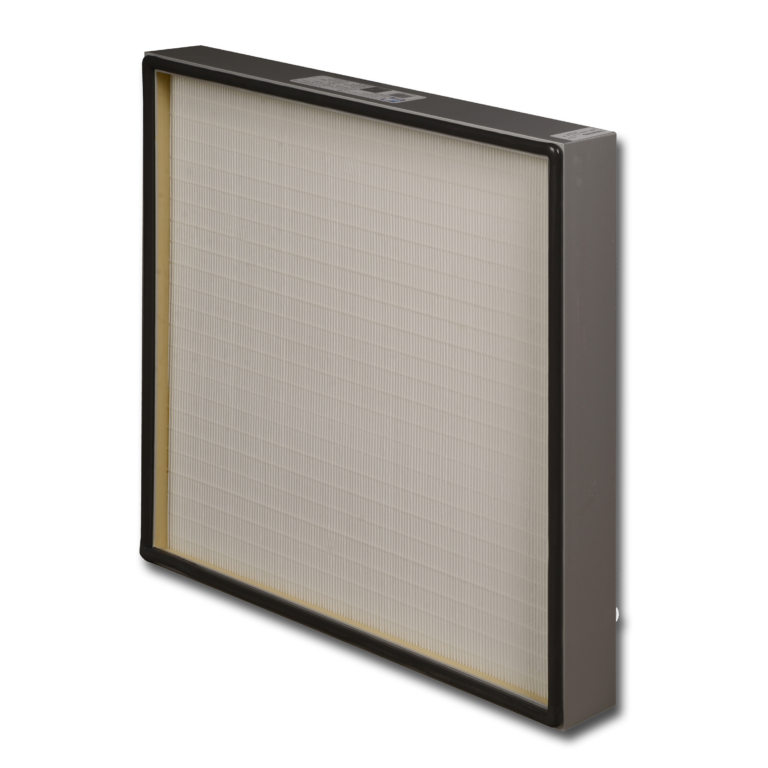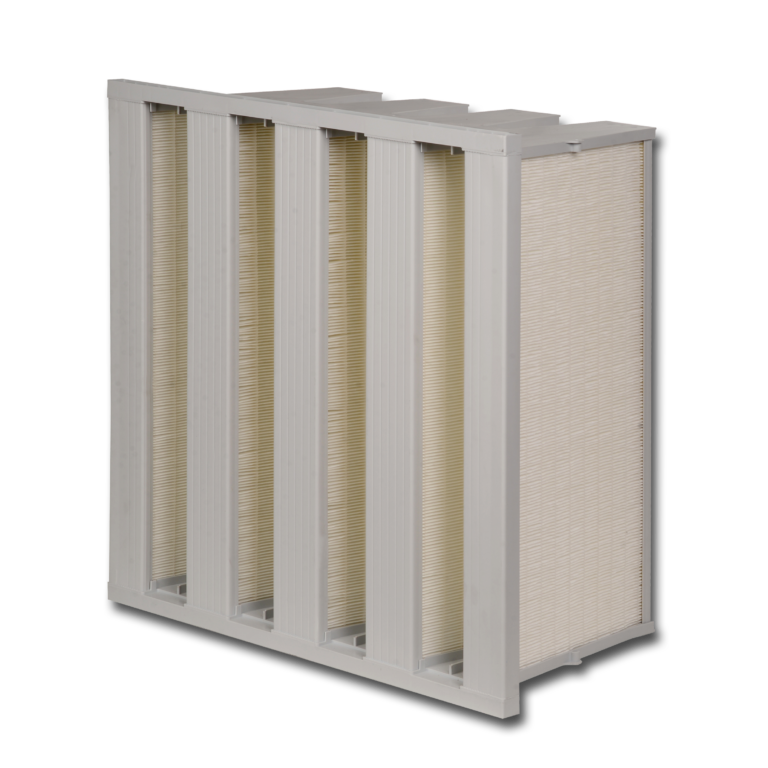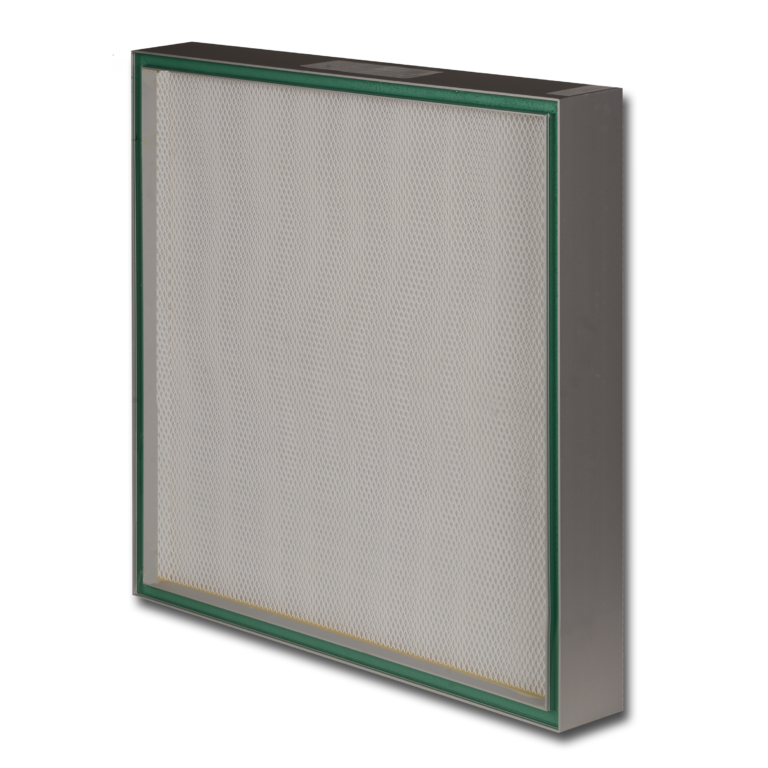
E10, E11 and E12 are EPA filters, and EN 1822-1:2019 does not use a local leak scan to classify them. Their classification is based on overall efficiency at MPPS; the standard explicitly excludes Group E filters from leak testing for classification purposes. EN 1822-1:2019, section 6.5 and Table 1
So an E12 filter arriving without an H14-style scan report is not, for that reason, missing a required test. The first thing to check is whether the order requested the right filter class for the application.
E12 is not another name for HEPA
Under EN 1822, the groups are EPA, HEPA and ULPA. E10–E12 sit in Group E; H13 and H14 sit in Group H.
| Class | Group | Minimum overall efficiency at MPPS | Maximum overall penetration | Local MPPS classification limit |
|---|---|---|---|---|
| E10 | EPA | 85% | 15% | Not assigned |
| E11 | EPA | 95% | 5% | Not assigned |
| E12 | EPA | 99.5% | 0.5% | Not assigned |
| H13 | HEPA | 99.95% | 0.05% | Assigned |
| H14 | HEPA | 99.995% | 0.005% | Assigned |
Scroll the table sideways to see all columns →
These are overall class limits, not a promise that every particle size has exactly that penetration. The numerical comparison and group distinction are shown in the VDMA overview of filter classes.
E12 and H13 differ in both efficiency and testing. H13 has a lower permitted overall penetration and an individual filter-element leakage requirement. A similar-looking frame does not make an E12 filter meet the H13 requirements.
Legacy labels such as “H10,” “H11” and “H12” still appear in old documents and purchasing descriptions. For a current order, use the actual standard and class required. Do not let an old name silently turn an EPA order into a HEPA expectation.
Why a HEPA-style scan is the wrong acceptance test for EPA classification
A leak scan looks for local penetration above a defined criterion. But filtration itself also allows some particles through. The test must separate normal penetration from an unacceptable local leak.
Take an illustrative E12 element operating at its 0.5% overall class limit, with penetration spread uniformly across the face. It could meet its E12 overall requirement without a discrete hole. If somebody applied H14’s reference local MPPS limit of 0.025% to it, normal penetration in this simplified example would exceed that limit everywhere.
That result would show that the wrong limit was used. It would not prove that the E12 filter was damaged. These assumed values explain the mistake; they are not measurements from a product.
Pay attention to the words “for classification purposes.” It does not mean that nobody can move a probe behind an EPA filter, investigate a damaged assembly or agree an additional engineering test. It means there is no Group E local scan criterion under this classification scheme by which to declare an E12 element “scan passed” in the same sense as a HEPA element.
ISO 29463-4’s published scope reinforces the distinction: its filter-element scan method applies to the higher classes beginning at ISO 35 H. ISO 29463-4:2011
No scan does not mean no testing
EPA classification still needs evidence that the filter meets its overall-efficiency requirement. EN 1822-1:2019 describes the E-group efficiency assessment on a statistical basis, without requiring the same individual test route used for HEPA scan classification. EN 1822-1:2019, section 7.4.4
The overall-efficiency method and the local leakage method should not be confused. ISO 29463-5:2022 deals with determining filter-element efficiency at MPPS; it is a different part of the series from the scan-test method. ISO 29463-5:2022
Ask the supplier how the offered class is established and what records are supplied. A manufacturer may perform additional production checks, but you should not infer its sampling plan or per-unit testing policy from the class label alone.
A media certificate is also not the same as completed-filter evidence. Folding, assembly, framing and sealing occur after the flat media is made. The documentation should explain how the product offered is supported by its classification and production-control records.
What to request instead of an unsuitable scan report
For an E10, E11 or E12 purchase, put these points into the enquiry:
- Exact class and standard: E12 to EN 1822-1:2019, for example, rather than “approximately HEPA.”
- Specified airflow: the nominal flow and the actual operating range required.
- Resistance: the initial pressure drop at the specified airflow, plus the relevant operating limit.
- Performance evidence: the classification basis and the available efficiency report or declaration covering the offered model.
- Product traceability: model, dimensions, production identification and the record supplied with the delivery.
- Mechanical interface: gasket type and side, frame dimensions and the housing’s sealing surface.
If your quality procedure requires an individual test record for every supplied EPA element, raise that requirement before ordering. The supplier must state what it can measure and document under an agreed method. Do not solve the paperwork mismatch by asking for a HEPA scan certificate with “E12” typed into the class field.
Likewise, a missing scan requirement is not permission to accept physical damage or a poor fit. The filter still has to be manufactured, handled and installed as specified.
Check the edition when someone gives you an ISO equivalent
Older comparison tables show no ISO counterpart for E10 because earlier ISO 29463-1 editions began at a higher efficiency. The 2024 third edition includes ISO 05 E at 85% minimum overall efficiency, alongside ISO 15 E at 95% and ISO 25 E at 99.5%.
Those three overall thresholds correspond to E10, E11 and E12 respectively. Matching the thresholds does not automatically certify an existing product under the new class name. The supplier still needs evidence for the class it declares. Check the certificate’s standard and edition, not just a lookup chart. ISO 29463-1:2024 publication record, ISO 29463-1:2024 published-standard preview, Table 1
When the request for a scan reveals a wrong filter selection
Sometimes the customer does need HEPA-level individual leakage evidence. The problem is that the enquiry was written for E12.
Resolve that at specification stage. Establish the application’s required efficiency, individual leakage acceptance, airflow and installation test. If those requirements call for H13 or H14, select the corresponding product and confirm that the fan and housing can accommodate it.
Moving to H13 or H14 changes the filter specification, not just the paperwork. It can also change resistance and the operating point.
EPA remains a valid choice where its performance meets the design requirement. Ulpatek’s EPA ceiling-filter range includes E10, E11 and E12 models and identifies prefiltration for HEPA filters among its applications. Choose the required filtration stage first, then ask for the evidence appropriate to that stage.
Frequently asked questions
Can an E12 filter be supplied without an individual HEPA scan certificate?
Yes. E12 classification does not include the HEPA local leak-scan requirement. That does not remove the need for appropriate class and performance documentation. If you need additional individual measurements, agree their method and scope when ordering.
Is an E12 filter that passes an extra test automatically H13?
No. H13 classification requires compliance with its overall and local performance requirements under the applicable procedures. One additional measurement cannot replace the complete classification assessment or justify changing the label.
Does an EPA filter need a good gasket if no classification scan is required?
Yes. Air bypassing the filter is not being treated by its media. The gasket and housing must still match the specified design. The absence of a Group E classification scan does not make leakage or installation damage acceptable.
What should I do if the customer asks for “E12 HEPA, individually scan tested”?
Check the intended performance before quoting. E12 is EPA under EN 1822, so calling it HEPA can cause a specification error. Confirm whether the customer needs E12 overall filtration or an H-group filter with the specified individual leakage evidence.