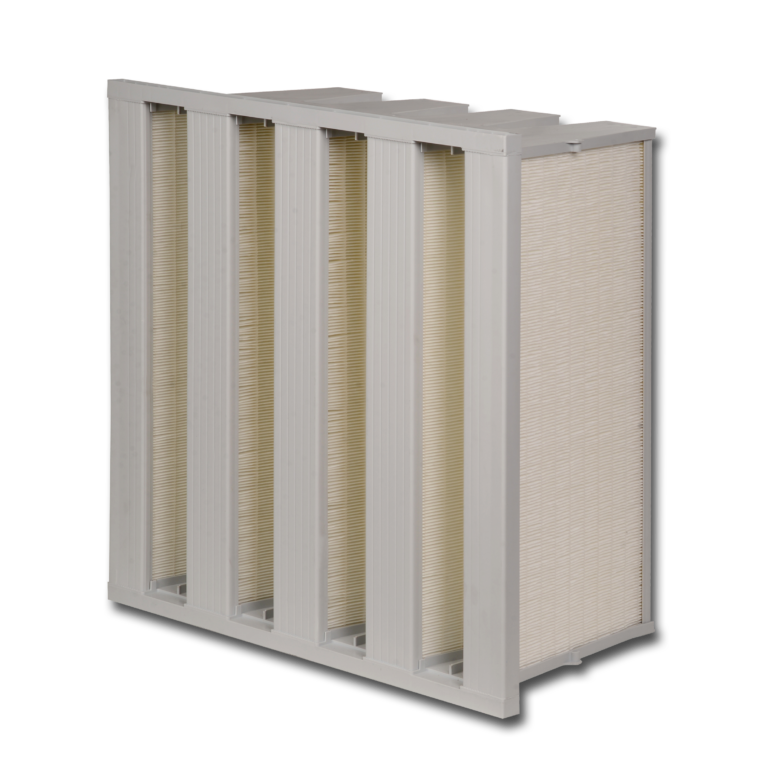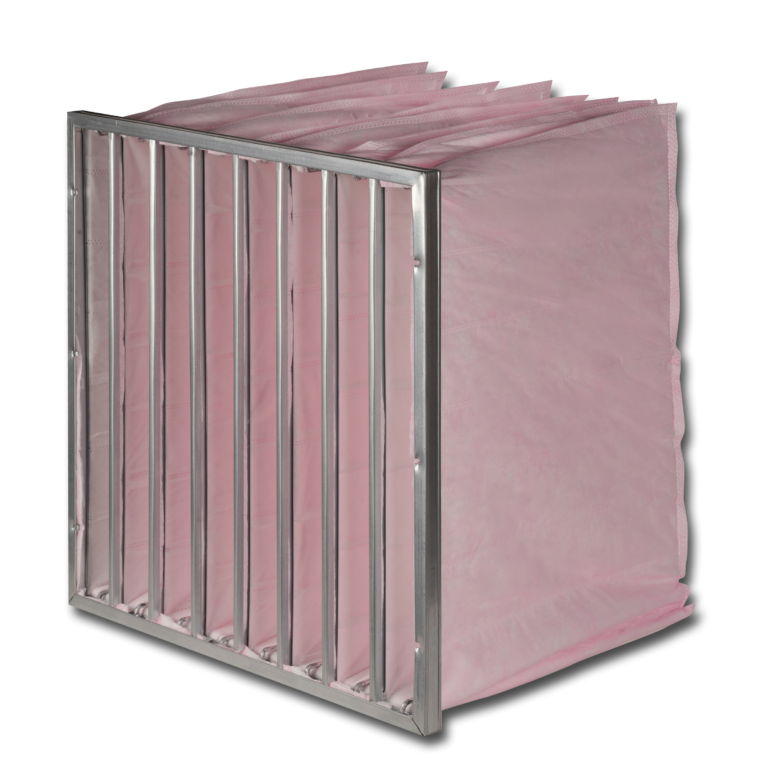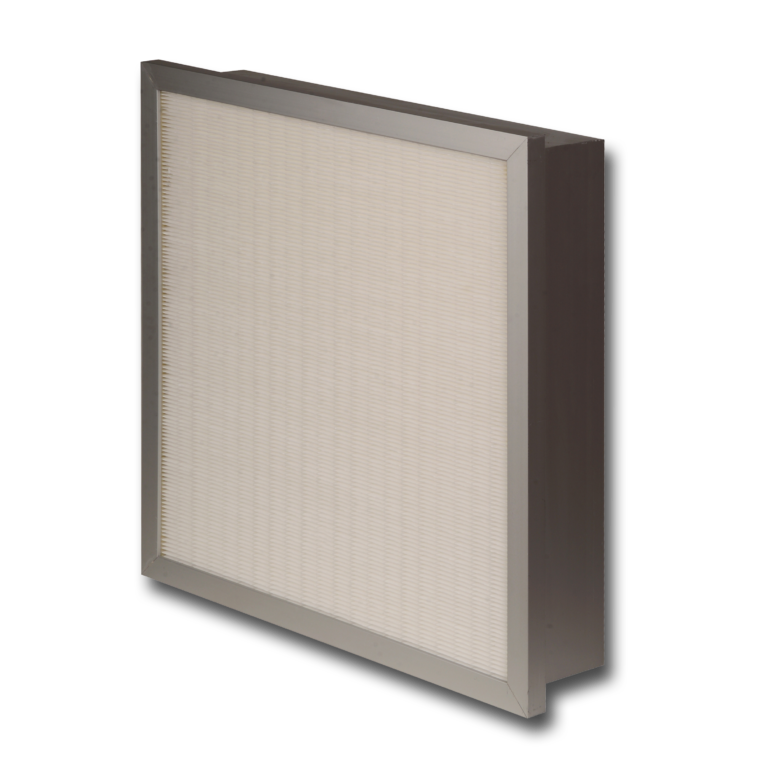
Choose the final AHU filter from the required supply-air quality and the performance of the complete filter train. Under Eurovent 4/23-2022, ePM1 50% can be sufficient for an ODA1/SUP2 selection; ODA3/SUP2 calls for 80% combined ePM1 efficiency, with a final stage of at least ISO ePM1 50%. Those are different requirements, and confusing them can produce an unnecessarily expensive specification—or an inadequate one. Eurovent 4/23-2022, Table 3
The practical decision is not “50 is cheap, 80 is safe.” It is whether a particular arrangement meets the duty with acceptable pressure drop, maintenance and installation constraints.
Write down what the percentage describes
ISO ePM1 50% and ISO ePM1 80% are general-ventilation filter classifications tied to the PM1 fraction. They are not percentages of every contaminant removed from every room, and they do not specify the removal of gases. ISO 16890-1:2016 defines the particulate-matter classification framework for general ventilation filters. ISO 16890-1
An ePM1 80% filter has a higher declared performance for that fraction than an ePM1 50% filter. It does not necessarily have a particular pressure drop, a particular service life or a particular frame depth. Those properties belong to the selected product.
When a quotation arrives, ask for the ePM values and the full model reference. “Equivalent to F9” is not enough. The legacy EN 779 class may help identify the previous product, but it does not replace the new filter's measured ISO 16890 data.
Also check whether someone has copied a measured value from a report or a rounded classification from the label. Use consistent definitions in the calculation. A procurement requirement should not move between them without explanation.
The final stage is not always the total system requirement
The following examples isolate the decision most buyers face. They are selections from the Eurovent matrix, not a replacement for the full recommendation or an instruction to assign every building to SUP2.
| Established project condition | Recommended combined efficiency | Final-stage minimum | What this means for the enquiry |
|---|---|---|---|
| ODA1 / SUP2 | ePM1 50% | ISO ePM1 50% | A suitable single final filter may meet both requirements |
| ODA2 / SUP2 | ePM1 70% | ISO ePM1 50% | Assess the entire proposed train; an isolated “50%” label cannot establish the total |
| ODA3 / SUP2 | ePM1 80% | ISO ePM1 50% | Compare an 80% final filter with any proposed staged alternative using a documented calculation |
| ODA2 / SUP1 | ePM1 80% | ISO ePM1 50% | The more demanding supply target changes the selection even at the same outdoor category |
Scroll the table sideways to see all columns →
The matrix values and final-stage conditions come from Eurovent 4/23-2022, Table 3 and its footnotes. Outdoor and supply categories must first be established from the project; the class of the old filter does not establish them.
For the current outdoor thresholds and complete table, see Are You Still Using the Old ODA/SUP Table?. Here, the task is to turn the selected duty into a quotable filter arrangement.
Compare three arrangements, not two labels
Assume a designer has established an 80% combined ePM1 requirement and the applicable final-stage minimum. Three enquiries could follow:
- A single final filter with the required ePM1 performance, together with any first-stage protection required for the system.
- A two-stage combination whose calculated ePM1 performance meets the requirement.
- A higher-performance final filter, provided the fan and project requirements justify the additional duty.
An illustrative calculation shows why stages matter. If the relevant ePM1 efficiencies of two filters are 50% and 60%, the simplified combined estimate is 1 − 0.50 × 0.40 = 80%. This is not the same as saying every coarse prefilter contributes 50% ePM1, nor is it a claim that two labels establish an exact installed result.
Eurovent permits a simplified engineering estimate but explains that the first stage changes the size distribution reaching the next. Use the underlying performance data where greater accuracy is needed, particularly when the estimate just touches a required limit. Eurovent 4/23-2022, section 5
The useful supplier response therefore names both models, their relevant efficiencies and the calculation method. “We always use this combination” is not a calculation.
Check that the fan can deliver the flow after the change
Before approving an upgrade, compare pressure drop at the same airflow per filter. A filter quoted at 3,400 m³/h and another quoted at 4,250 m³/h cannot be compared by reading their catalogue resistance values side by side.
Then check the loaded condition. Suppose a terminal branch has 180 Pa available for its final filter at the required flow. Candidate A starts at 90 Pa and candidate B at 140 Pa. Both fit the clean-filter pressure budget, but B begins with less operating margin. These figures are hypothetical; they illustrate why a clean-filter check alone is incomplete.
The fan response also matters. With suitable constant-flow control, increased resistance usually requires more fan input to retain flow. A fixed-speed system may instead deliver less air. A proposed higher class that quietly reduces the ventilation rate has changed two design variables, not one. US Department of Energy, fan-system sourcebook
Do not infer that ePM1 80% is always more restrictive than every ePM1 50% product. Compare actual constructions. More available media area, a different depth or a different pack design can change the answer.
A comparison sheet that prevents a false economy
Ask suppliers to complete the same fields for each proposal:
| Comparison field | Required basis |
|---|---|
| Filtration duty | Same combined ePM fraction and efficiency; same final-stage condition |
| Mechanical fit | Same permitted frame dimensions, depth and seal interface |
| Operating point | Same airflow per filter and stated flow distribution |
| Resistance | Initial value and usable loading data, with test conditions |
| Replacement | Agreed operational, hygiene and pressure criteria |
| Annual cost | Product, labour, disposal and fan energy using common assumptions |
Scroll the table sideways to see all columns →
If one proposal requires a new housing section, include that work. If another uses more frequent first-stage changes to protect the final stage, include the labour. The purchase price of one final filter does not answer the annual-cost question.
Eurovent 4/24-2023 addresses energy estimation under actual operating conditions; its purpose differs from a fixed-condition certification label. Use an operating calculation for the project rather than presenting a label's reference consumption as the building's electricity bill. Eurovent 4/24, Update 1
When 80% is the wrong answer to the right concern
A more efficient particle filter does not correct a bypass gap. It does not remove an indoor gas source. It does not compensate for a supply system that is switched off during occupied periods. Identify the failure you are trying to correct before changing the filter class.
Likewise, the matrix does not establish the entire contamination-control design for a cleanroom, operating theatre or exposed pharmaceutical process. Such applications may require terminal HEPA filtration and additional qualification. The AHU fine-filter stage remains important, but its selection is only one part of that arrangement.
For an existing AHU, record the installed filter arrangement, actual flow, available pressure and reason for the proposed change. For a new AHU, ask the designer to identify the required ODA/SUP selection and its basis. That turns “50% or 80%?” into a decision the manufacturer can answer.
Related product information: fine-dust filter range.