For an AHU in the Gulf, North Africa or Central Asia, “desert conditions” is not a complete filter specification. The site may face coarse sand, fine dust, coastal moisture, construction activity, high temperature or seasonal cold. These conditions can occur in different combinations.
Select the intake and filter train around the local exposure, with enough pressure and maintenance capacity for severe loading events. A strong first stage can be useful, but it does not remove the need for fine-particle control downstream.
Describe the site instead of the region
WMO notes that sand and dust activity varies with geography, climate and local environmental factors. Dust can also travel far from its source. The filter burden at a site is therefore not defined by its country name alone. WMO: sand and dust storms
Record the intake location, surrounding land use, prevailing exposure and known seasonal events. Use available local air-quality data and the facility's own measurements. Include humidity, rain or fog exposure, and the temperatures actually reaching the filter.
For Central Asian sites, ask about winter operation as well as summer dust. For coastal sites, investigate moisture and salt exposure rather than assuming a dry environment. For an inland urban site, nearby construction may dominate a particular season.
The goal is a duty profile the supplier can use. “Suitable for the Middle East” does not explain that profile.
Separate the intake's jobs
An intake can provide weather protection, large-debris exclusion and, where selected, sand separation. The filter bank then controls the remaining particle burden to the required level.
Do not treat a sand-trap louvre's rating as evidence that it removes the full dust-storm aerosol. Ask for its test method, test particles and operating airflow. ANSI/AMCA 500-L provides laboratory methods for louvre performance; it does not set the performance level your project must accept. Keep the downstream fine-filter requirement separate. ANSI/AMCA 500-L
Allow access for the material it separates and ensure that drainage or collection features can function. A separator with a blocked discharge path can lose its intended benefit.
Also check building infiltration. Open loading doors and poorly sealed plant rooms can admit dust outside the filtered supply route.
Choose each filter stage for a defined burden
| Stage or feature | What it can contribute | What to verify |
|---|---|---|
| Intake separation | Reduce large sand or debris entering the filter bank | Particle-dependent performance, velocity and clearing access |
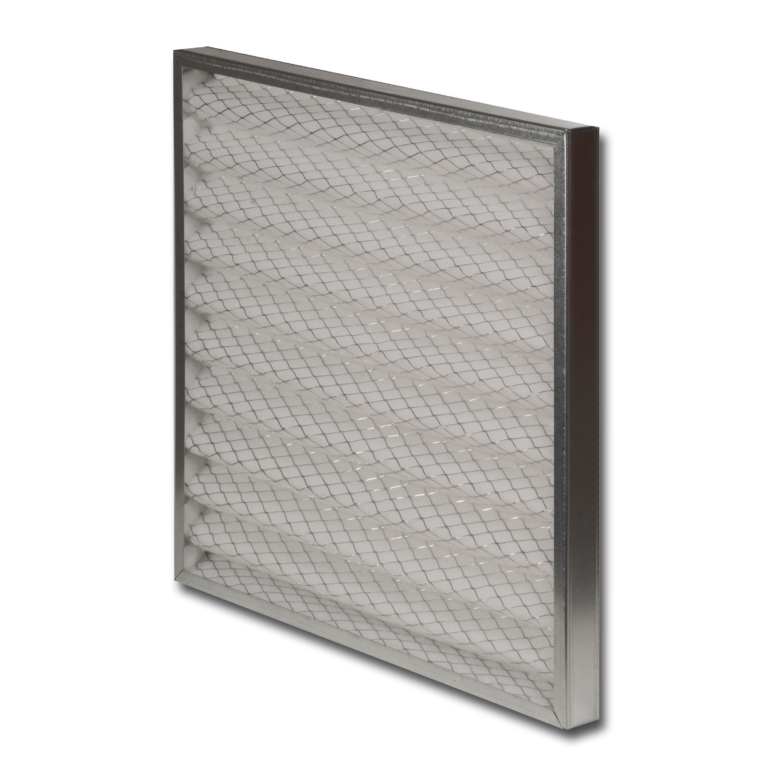
| Coarse or selected prefilter | Take an economical share of the loading | Efficiency, holding behaviour and replacement access |
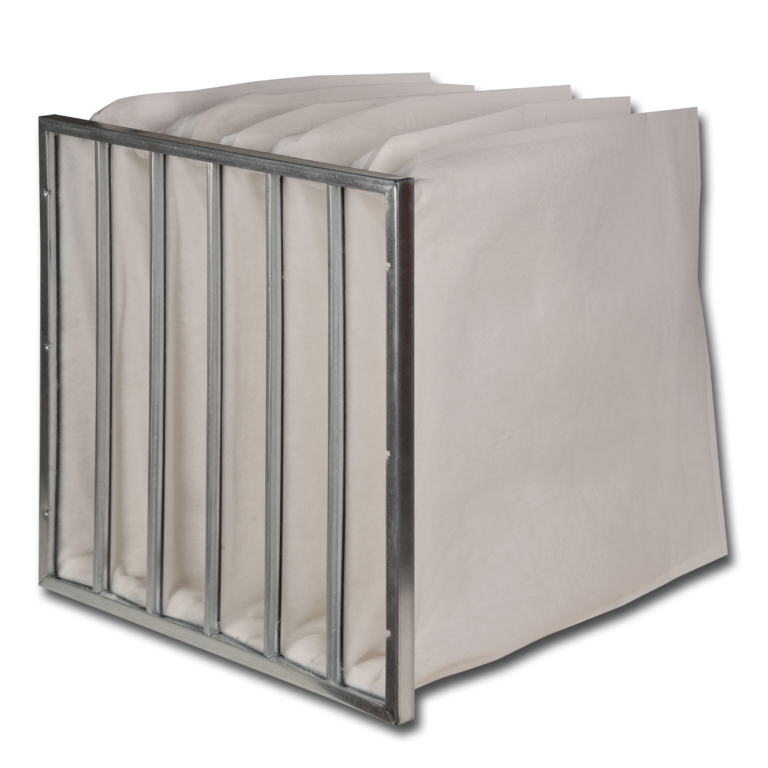
| Fine filter | Reduce the remaining smaller particles | ISO 16890 class and selected airflow resistance |
| HEPA stage, where required | Meet a defined high-efficiency particle duty | Process need, housing seal and fan capacity |
| Moisture protection | Limit water reaching unsuitable components | Entire intake arrangement and actual exposure |
Scroll the table sideways to see all columns →
Choose the final air-quality objective before optimising stage life. A longer interval is not a benefit if it allows an unacceptable amount of fine dust through the system.
Eurovent 4/23 gives a general ventilation approach based on outdoor and supply-air quality. It can support the AHU selection, but a severe short dust event needs its own loading assessment alongside long-term air-quality data. Eurovent 4/23
Estimate how quickly the burden can change
The incoming particle mass rate is approximately concentration multiplied by airflow, when both use compatible units and conditions.
For an illustrative AHU handling 20,000 m³/h, an assumed concentration of 0.10 mg/m³ represents 2 g/h entering the intake. At 2.0 mg/m³, it becomes 40 g/h. A ten-hour event at the higher concentration presents 400 g to the intake before considering separation and filtration.
These are calculation assumptions, not regional measurements or a filter-life prediction. The fraction retained at each stage depends on the particle distribution and stage performance. The example shows why a monthly calendar can miss a rapid loading event.
Use actual monitoring and inspection to refine the maintenance plan. WMO's dust bulletins and regional warning systems can help facilities anticipate events, but a forecast does not replace the AHU's own operating checks. WMO airborne dust bulletins
Compare holding capacity at the same endpoint
A dust-holding-capacity figure needs a test dust, airflow and final resistance. Results obtained under different conditions are not a fair basis for a life claim.
ISO 16890-3:2024 addresses gravimetric efficiency and resistance in relation to captured test-dust mass. A laboratory loading curve helps compare defined performance; it does not state how many weeks a filter will last at a particular desert site. ISO 16890-3:2024
Ask for the curve, not only the final grams. If the AHU reaches its usable pressure limit earlier than the test endpoint, some of the published holding capacity may be unavailable in that installation.
Also check the bank layout. More effective area can reduce the burden per element, but the frame arrangement, face velocity and airflow distribution must support the selection.
Heat and moisture need separate confirmation
State the continuous operating temperature and any short excursion with its duration. The temperature limit applies to the complete selected filter, including frame, adhesive and gasket. A robust media material does not establish the limit of the assembly.
Ulpatek's published ranges include different constructions and temperature duties. Select from current model data and ask for written confirmation where the duty falls outside it. Ulpatek technical catalogue, HEPA temperature limits
Moisture can affect pressure and mechanical behaviour differently from dry dust. If fog, mist or water carry-over is credible, request relevant evidence. ISO 29461-2 provides a fog-and-mist endurance test for rotary-machinery intake filters; its existence also illustrates why dry particle efficiency does not establish wet performance. It is not a general HVAC requirement for every site. ISO 29461-2:2022
Build an event-based maintenance plan
Record initial pressure at the required airflow and monitor the stages separately where practical. Define action levels from the fan capacity, filter limits and required supply performance. An upstream stage loading rapidly should be distinguishable from a downstream stage reaching its own limit.
Plan checks after a major dust event, using the facility's access and handling procedures. Look for bypass, damaged media, water entry and changes in airflow. Do not clean or pulse a disposable filter unless its manufacturer explicitly permits that method for the product.
Stock planning should reflect both routine use and event demand. Keep approved replacement codes, sealed storage and a route for rapid replenishment. The required quantity depends on the site's consumption and procurement uncertainty; it cannot be set reliably from geography alone.
Send a useful harsh-climate RFQ
The right train handles the ordinary operating burden and gives the facility a workable response when conditions become severe. That requires good intake design, suitable filters and a maintenance plan that reacts to the actual event.