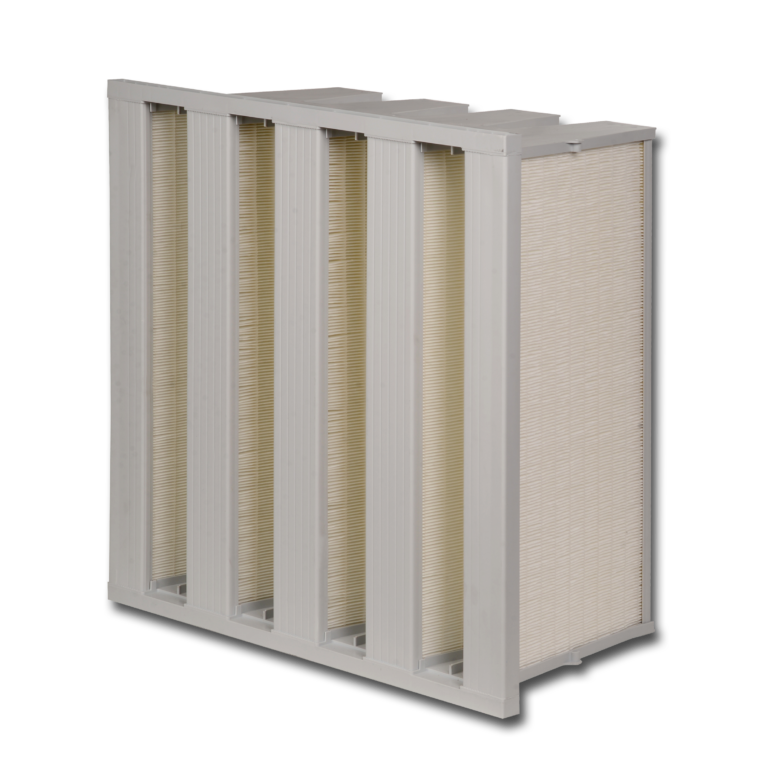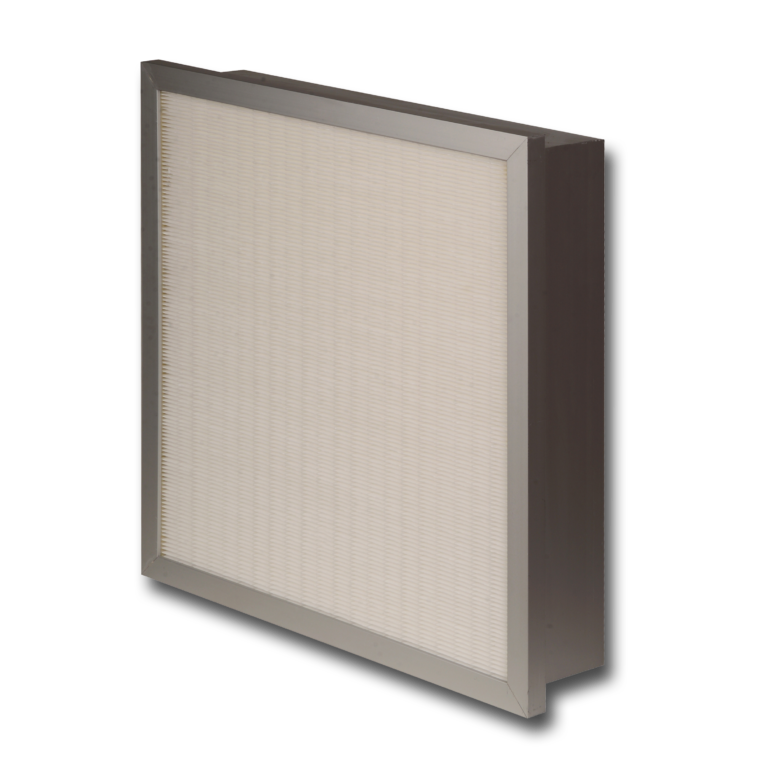
A €45 filter can cost less to operate than a €30 filter. The purchase price is paid once per change; the electricity cost continues whenever the system runs.
To compare them properly, calculate the energy associated with each filter's average pressure drop, then add purchase, maintenance and disposal costs over the same period. Keep the required filtration performance and delivered airflow in view throughout the comparison. A cheaper result obtained by delivering less clean air is a different duty.
The example below shows the arithmetic, including a pressure-drop mistake that can change the answer by a large amount.
First, define what the calculation covers
For a one-year operating comparison, use:
Annual filter-related cost = filter purchases + fan electricity needed to overcome filter resistance + change labour + disposal and other relevant costs.
This is a simplified annual total-cost-of-ownership calculation. A full multi-year life-cycle-cost analysis can also include installation, financing assumptions, changes in prices and when future costs are paid. Eurovent's life-cycle-cost guidance separates investment, energy, maintenance and disposal; its 2005 publication is useful for that accounting structure, while its old filter-class references should not be used as a current selection specification. Eurovent 4/10, Calculating Life Cycle Cost for Air Filters.
A passive filter does not draw electrical power itself. The fan supplies the pressure needed to move air through it. This distinction also appears in Eurovent's 2026 guide to environmental product declarations for air filters. Eurovent, EPD Guide for Air Filters, section 2.3.
The energy formula—and the pressure value it needs
For constant airflow and a constant assumed overall efficiency:
E = q × Δp̄ × t ÷ (1,000 × η)
| Symbol | Meaning | Unit or format |
|---|---|---|
| E | Electricity attributed to overcoming the filter's resistance | kWh |
| q | Airflow through the filter | m³/s |
| Δp̄ | Time-average pressure drop over the period | Pa |
| t | Operating time | hours |
| η | Overall efficiency from electrical input to useful air power | Decimal: 0.70 means 70% |
Scroll the table sideways to see all columns →
Eurovent 4/24–2023, Update 1, provides a method for estimating filter-related energy under operating conditions. It uses average pressure drop; standardised filter-energy comparisons are addressed separately by Eurovent 4/21. The calculation here is a transparent engineering example, not a Eurovent certification result. Eurovent 4/24, sections 1–2.
Be careful with units. Divide m³/h by 3,600 before putting the airflow into this equation. Enter operating time in hours and efficiency as a decimal. The factor of 1,000 converts watt-hours to kilowatt-hours; it does not convert hours into seconds.
If flow, pressure and efficiency change enough to affect the result, divide the record into time intervals and calculate the energy for each interval. Multiplying separate annual averages can hide how those values changed together.
Final minus initial is not average pressure drop
Suppose a filter starts at 100 Pa and finishes at 200 Pa.
- Its increase in resistance is 200 − 100 = 100 Pa.
- If resistance rises linearly with operating time, its average is (100 + 200) ÷ 2 = 150 Pa.
Those two values answer different questions. Substituting the 100 Pa increase for the 150 Pa average leaves out part of the resistance the fan had to overcome throughout the period.
The midpoint is still an assumption. It fits this example because we assume the resistance rises at a constant rate with time. It is not a substitute for a measured loading curve, and a curve against laboratory dust mass is not automatically the same as a curve against operating hours.
A worked comparison: €45 versus €30
The starting values below come from the example on page 68 of Ulpatek's published technical catalogue. They are historical example inputs, not current prices or a measured prediction for a customer's installation. We recalculate energy using an explicit assumption that each filter's resistance rises linearly over the same 6,000 operating hours. Ulpatek Product Technical Catalogue, page 68.
Both candidates must meet the application's required filtration performance. The source example lists ePM1 85% and ePM1 80%, respectively; they should not be described as identical ISO 16890 ratings. If the project requires 85%, the 80% candidate does not meet that stated requirement, regardless of its cost.
| Input | Filter A | Filter B |
|---|---|---|
| Airflow | 3,400 m³/h | 3,400 m³/h |
| Initial pressure drop | 100 Pa | 120 Pa |
| Assumed pressure drop at the end of 6,000 hours | 200 Pa | 320 Pa |
| Assumed time-average pressure drop | 150 Pa | 220 Pa |
| Operating hours per year | 6,000 | 6,000 |
| Assumed overall efficiency | 0.70 | 0.70 |
| Assumed electricity tariff | €0.283/kWh | €0.283/kWh |
| One filter purchase per year | €45 | €30 |
| Maintenance and other costs in this example | €6 | €6 |
Scroll the table sideways to see all columns →
Airflow conversion:
3,400 ÷ 3,600 = 0.944444 m³/s
For Filter A:
Eₐ = 0.944444 × 150 × 6,000 ÷ (1,000 × 0.70) = 1,214.29 kWh/year
For Filter B:
Eᵦ = 0.944444 × 220 × 6,000 ÷ (1,000 × 0.70) = 1,780.95 kWh/year
Using unrounded values until the final step gives:
| Annual result | Filter A | Filter B |
|---|---|---|
| Electricity attributed to filter resistance | 1,214.29 kWh | 1,780.95 kWh |
| Electricity cost | €343.64 | €504.01 |
| Purchase, maintenance and other example costs | €51.00 | €36.00 |
| Total included annual cost | €394.64 | €540.01 |
Scroll the table sideways to see all columns →
Under these assumptions, Filter A costs €145.37 less per year, a 26.9% reduction in the costs included in this example. Its purchase price is €15 higher, while its calculated electricity cost is €160.37 lower.
These are calculated outcomes from stated inputs. They do not establish a universal saving for Filter A, nor do they include an unlisted production shutdown, a separate disposal charge or a second replacement during the year. Add those costs where they apply.
How little resistance difference can recover a higher purchase price?
The same inputs provide a useful buying check. At 3,400 m³/h, 6,000 hours and 70% overall efficiency, each 10 Pa reduction in average pressure drop saves approximately 80.95 kWh/year. At the assumed tariff, that is €22.91/year.
If the only extra annual cost is a €15 extra purchase cost, its break-even average-pressure advantage is:
€15 × 1,000 × 0.70 ÷ (0.944444 × 6,000 × €0.283) = 6.55 Pa
This is why a small price difference should not decide the order before checking the resistance data. It is also why the operating hours and tariff matter. With shorter operation, a lower tariff or additional replacement costs, the break-even point changes.
Four ways to make a cost comparison look better than it is
Using clean-filter resistance for the whole year. The initial value describes one point. It cannot show how the filter loads. Ask for the basis of the average value and distinguish a measured record, a laboratory result and a model assumption.
Giving one filter more working hours than another. If one candidate requires two changes in the comparison period, include two filter purchases and the associated labour, disposal and any verification. A lower final-pressure target can reduce energy while increasing the number of changes.
Counting lower airflow as an energy improvement. Compare at the required delivered airflow. In a fixed-speed system, changing resistance can shift the fan's operating point. The lower-resistance filter does not guarantee the electricity reduction predicted by a constant-flow model. Evaluate the fan, controls and system together. DOE, Improving Fan System Performance.
Calling an assumed figure a certified result. A Eurovent energy label is obtained under the certification programme's defined conditions. A site calculation answers another question using site inputs. Check the certified product, dimensions, duty and published characteristics rather than attaching a certification claim to a spreadsheet. Eurovent Certita Certification, Air Filters programme overview.
What to ask for with a filter quotation
For an initial comparison, a clearly labelled estimate is useful. For a substantial purchase, replace assumptions with operating records or a properly specified trial wherever possible. Keep airflow and filtration requirements fixed, and record each change.
The purchasing question then becomes specific: does the lower average resistance recover the extra filter and maintenance cost in our installation? That can be answered with numbers. A lower unit price cannot answer it on its own.
Questions about the calculation
Are these the total energy costs of the AHU?
No. The equation estimates the electricity associated with overcoming the selected filter's resistance under the stated assumptions. Coils, ductwork, dampers, other filter stages, heating, cooling and other loads are outside that calculation.
Can I use the average of initial and final pressure drop?
You can use it as an explicitly labelled approximation when assuming resistance rises linearly with operating time. For better accuracy, use data for separate time intervals or a model with a clear basis. Subtracting initial from final pressure gives the increase, not the average.
Does a higher filter class always consume more energy?
Class alone cannot provide the energy figure. Actual airflow, construction, media area, pressure drop through the service period and system operation determine the result. Establish the required filtration performance first, then compare suitable products.
Is a one-year calculation the same as full life-cycle cost?
No. A one-year comparison can support a purchasing decision, but a full life-cycle analysis may include initial investment, repeated changes, disposal, discounting and price changes over several years. State the boundary so the reader knows what the total includes.
Sources
- Ulpatek Product Technical Catalogue, July 2024, page 68: historical inputs; energy recalculated here with explicit assumptions.
- Eurovent 4/24–2023, First Edition, Update 1: operating-condition energy evaluation.
- Eurovent 4/10, 2005: life-cycle cost components.
- Eurovent, EPD Guide for Air Filters, 2026.
- US Department of Energy, Improving Fan System Performance.
- Eurovent Certita Certification, Air Filters programme overview.