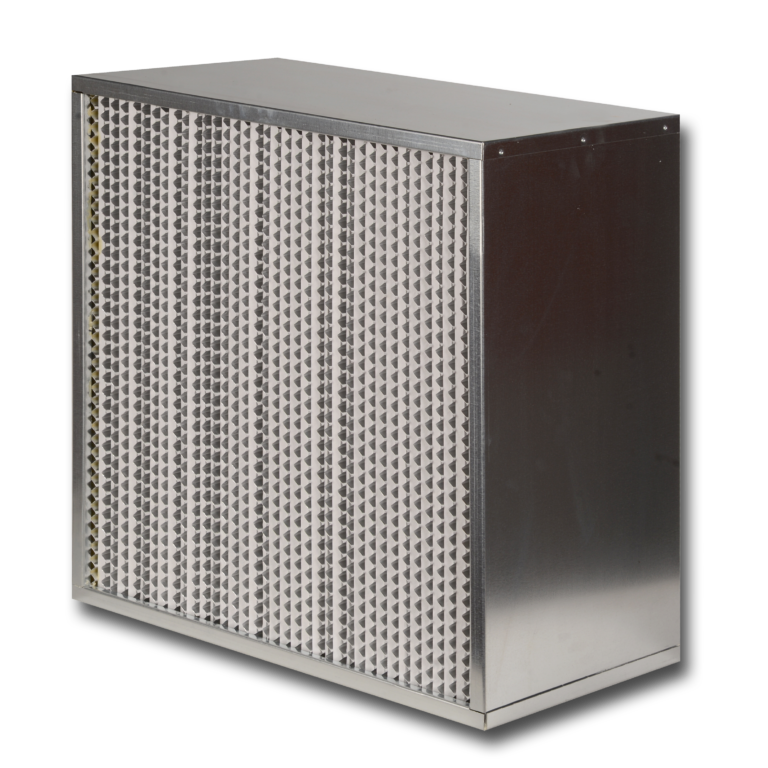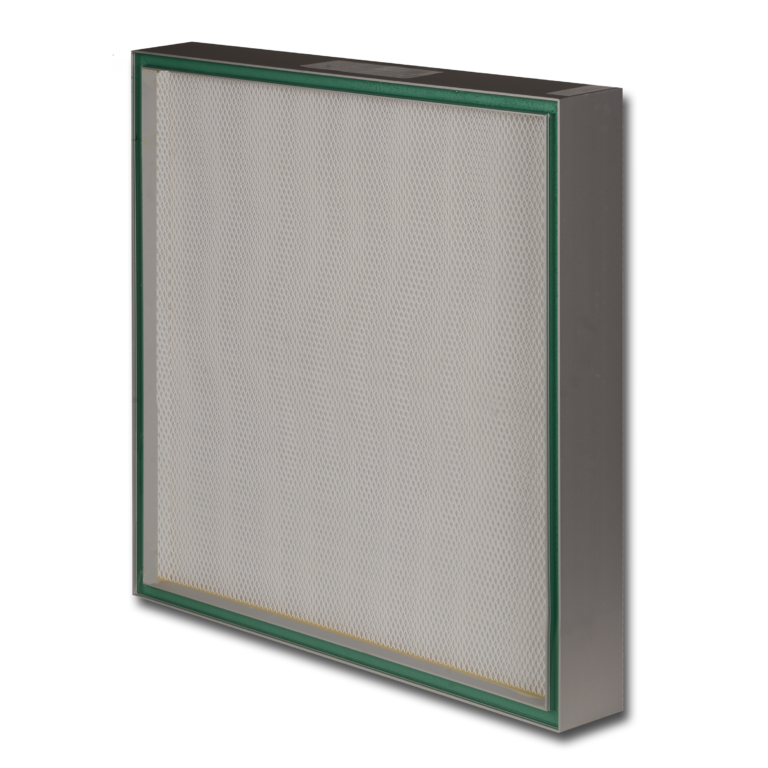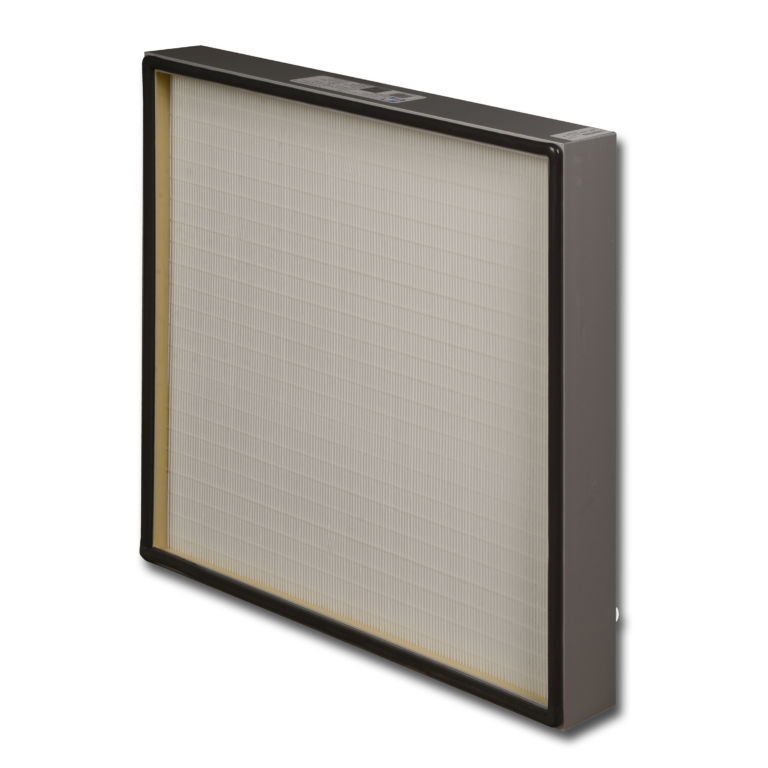
There is no single maximum operating temperature for HEPA filters. The rating applies to the complete filter model: Ulpatek, for example, publishes 80°C for its gel ceiling filter and continuous ratings of 120°C or 260°C for specified metal-frame HCA configurations. Ulpatek gel ceiling filter, Ulpatek HCA model table
If your process runs at 250°C, an H14 label alone tells you nothing about whether the filter can survive it. You need the temperature rating, exposure duration, heating and cooling limits, airflow conditions and performance requirements for the selected construction.
“Up to 260°C” is the beginning of the specification
A useful temperature specification answers five separate questions:
| Item | What the purchaser needs to know |
|---|---|
| Continuous temperature | The permitted operating temperature for sustained service under the stated conditions |
| Peak temperature | Any permitted short rise above the continuous rating, including duration and repeat limits |
| Heating and cooling rates | How quickly temperature may change, including start-up and shutdown |
| Conditioning requirements | Any prescribed tempering, burn-in or other preparation before process release |
| Performance basis | Which efficiency, integrity, airflow and pressure-drop requirements apply, and when they are verified |
Scroll the table sideways to see all columns →
A continuous rating does not automatically allow temperature overshoot. A short peak rating cannot be used as the continuous operating temperature.
A specification that says only “HEPA, 250°C” leaves enough ambiguity to select the wrong filter.
What Ulpatek's published temperature ratings actually cover
The HCA product page distinguishes temperature variants in the order code and labels the model-table column as maximum continuous temperature. The following examples are taken from that table.
| Ulpatek model | Class | Published continuous temperature |
|---|---|---|
| HCA-H13-G-W-T-W-610-610-292-FW-S | H13 | 120°C |
| HCA-H13-SS-W-HT-W-610-610-292-FB-S | H13 | 260°C |
| HCA-H14-G-W-T-W-610-610-292-FW-S | H14 | 120°C |
| HCA-H14-SS-W-HT-SG-610-610-292-FB-S | H14 | 260°C |
Scroll the table sideways to see all columns →
The T and HT options identify different temperature configurations. The fact that the family lists several frame and gasket materials does not mean every combination has the 260°C rating. Specify permitted peak exposure and heating/cooling rates separately for the selected model and operating cycle; the continuous-temperature figure does not define them. Ulpatek HCA specifications and order code
The glass fibres are not the whole filter
Looking up the heat resistance of glass fibre and using that figure as a filter rating is a mistake. A HEPA filter is an assembly, and its components perform different jobs.
| Part | What must remain functional at temperature |
|---|---|
| Filter media | Its structure and specified filtration performance |
| Separators | Pleat spacing and mechanical support |
| Pack-to-frame sealant | The seal between the filter pack and its frame |
| Peripheral gasket or other seal | The seal between the filter and its housing |
| Frame and mounting arrangement | Alignment, support and the required sealing load throughout the cycle |
Scroll the table sideways to see all columns →
An aluminium separator is useful information, but it is not a temperature certificate. Check the sealant, gasket, frame and complete approved configuration as well. Likewise, a stainless-steel frame does not convert a standard filter pack into a high-temperature pack.
A silicone gasket does not make every filter suitable for 260°C
The material name alone is not enough. Silicone grades, gasket designs and bonding methods vary. Replacing the perimeter gasket also leaves the pack-to-frame bond and separators unchanged.
If a filter's assembly rating is 80°C, use that rating until the manufacturer supplies a separately rated construction. Do not “upgrade” the temperature limit by changing one visible component.
Repeated heating and cooling can matter more than the hold temperature
A filter in a continuously operating hot-air system sees a different duty from a filter taken from room temperature to its process temperature several times each day. Both enquiries may say “260°C,” but their heating and cooling cycles are different.
Request both heating and cooling limits. Record the number of cycles, time at temperature, expected overshoot and shutdown sequence. Check the emergency cool-down as well as the normal cycle.
A simple calculation shows the production implication. A 200°C temperature rise takes 100 minutes at 2°C/min and 40 minutes at 5°C/min, before any holding periods. This is an arithmetic illustration, not a recommended ramp profile. The permissible rate must come from the filter and equipment specifications.
Start-up requirements cannot be borrowed from another product
Obtain the procedure for the exact filter and equipment combination. Include any required post-conditioning inspection or testing in the process qualification plan.
State the airflow temperature, not just the airflow number
For a hot-air application, “1,000 m³/h” needs reference conditions. Actual hot volume flow and volume flow expressed at a reference temperature are different quantities.
For the same mass flow at approximately the same absolute pressure, an ideal-gas estimate gives:
Hot volume flow / reference volume flow = hot absolute temperature / reference absolute temperature.
For example, 1,000 m³/h at 20°C corresponds to approximately 1,819 m³/h at 260°C, if mass flow and absolute pressure are unchanged: 1,000 × 533.15 / 293.15. This calculation describes gas expansion. It does not predict the operating point of an oven fan or the filter's hot pressure drop. NASA Glenn Research Center: equation of state
Tell the supplier whether the flow is actual at operating temperature or referenced to other conditions, and state those conditions. Ask for the applicable resistance data and fan selection. A room-temperature catalogue point does not describe the complete hot operating duty.
Also identify where temperature is measured. The chamber setpoint is not necessarily the maximum air temperature at the filter. Provide the filter-location temperature profile, including any known differences across the filter, rather than relying only on the value shown on the operator's screen.
Separate the factory test from hot-process qualification
Ask what the certificate actually establishes. Was the filter tested at ambient temperature? Was any test performed after thermal conditioning? What performance has been demonstrated during or after repeated cycles?
At Ulpatek, ULPALAB is the internal laboratory used to test Ulpatek's own filters before shipment. That does not replace the equipment owner's responsibility to define and verify the installed process requirements. Agree the required documentation with the filter supplier and the equipment or qualification team before purchase.
What to send with a high-temperature HEPA enquiry
Send the exact filter dimensions and mounting drawing, required class, airflow and reference conditions, continuous temperature at the filter, peak temperature and duration, heating/cooling profile, cycle frequency, process atmosphere and required verification documents.
That is enough to begin an engineering selection. “H14 with silicone gasket, 260°C” is not.
Can an H14 filter tolerate more heat than an H13 filter?
Not because of its class. H13 and H14 describe filtration performance. Temperature capability comes from the specified construction. Ulpatek's model table includes both classes in 120°C and 260°C configurations.
Can I run above the continuous rating for a few minutes?
Only if the manufacturer explicitly permits that excursion for the model, duration and cycle conditions. If no peak allowance is stated, ask for one before operating above the continuous rating.
Is a high-temperature HEPA filter automatically suitable for steam?
No. A dry hot-air rating does not establish compatibility with saturated steam, condensation or a steam-sterilisation cycle. Send the actual atmosphere and pressure conditions so the supplier can assess the application.